About
Site Directory
Copyright © 2026 www.yabstabrighton.com
All Right Reserved
powered by 

Copyright © 2026 www.yabstabrighton.com
All Right Reserved
powered by
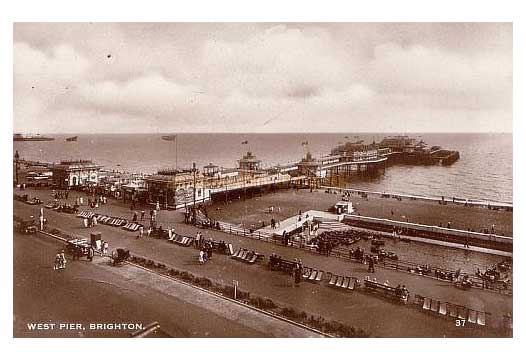
Brighton's West Pier was designed and engineered by Eugenius Birch to attract visitors and survive in the hostile environment of the seashore.
Right - The West Pier, Brighton in 1936 - From a Postcard.
Built in 1866, it was a simple and functional structure built out from the sea using dozens of cast iron threaded columns screwed into the seabed and strengthened by a lattice of ties and girders that provide the necessary strength to support the promenade deck whilst allowing seas to pass harmlessly through.
Originally the West Pier had an open deck with only six small ornamental houses of oriental design, two toll houses and glass screens at the pier head to protect visitors from the wind and sun. In 1875 a central bandstand was added.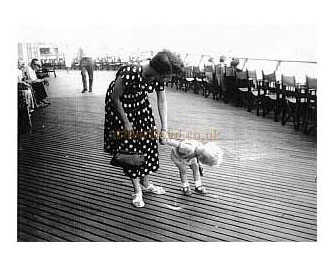
In the 1880's weather screens the full length of the pier, steamer landing stages and a large pier head pavilion were constructed.
The final building, completed in 1916, was a graceful concert hall. The result is seaside architecture at its finest, designed to attract and entertain holiday makers with all the pomp and frippery that is the essence of the English seaside resort. The pier is unique in being largely unaltered since that time, its proportions and style are unrivaled and its concert hall and theatre are two of the best surviving Victorian and Edwardian seaside entertainment buildings.
The West Pier is Britain's only Grade 1 listed pier and was built between 1863-1866, to the designs of Eugenius Birch, the most celebrated of all pier architects. The pier is shown above as originally built with two toll houses at the landward end, twin kiosks for shelter in the centre and ladie's and gentlemen's retiring rooms at the pier head. It was only later that the landing stage and theatre pavilion were added. The pier closed to the public in 1975 and has been the subject of a long-running, but ultimately successful, campaign to restore it to its full glory.
1875 - 77
The central section of the pier was widened and a covered bandstand built, providing shelter for the previously exposed musicians who had performed at the pier head.
1888
Covered orchestra stand with moveable awnings to shelter the audience was constructed on the pier head.
1890
A central windscreen was built the length of the pier neck.
1893
The pier head was widened and a large pavilion built with seating for 1400 people. R W Peregrine Birch, a nephew of ugenius, was the civil engineer in charge of the building. The reconstructed pier head included bathing accommodation for visitors.
1896
A landing stage of mild steel was constructed to cater for steamer excursions.
1901
The landing stage was enlarged.
1903
The pavilion was converted into a theatre with seating for 1000 people.
1914 - 16
The covered bandstand was demolished, the pier widened and a low eight sided oval concert hall seating 1400 was built around a skeleton of iron arches. The completion of the Concert Hall marked the end of the half century of building the West Pier.
There were no other significant additions and the structure that exists today, less the decay of the post war years, is essentially that which existed in 1916.
After four years, in which approximately £1.5m has been expended on strengthening the pier and conducting works necessary to plan the restoration, the Trust and its private sector partner, St Modwen Properties plc, have been undertaking the physical, financial, technical and business plans for the full restoration of the West Pier.
Those detailed plans were considered by the other three partners in the project (the Heritage Lottery Fund, English Heritage, Brighton & Hove Council) with a view to the final preparatory works happening throughout summer and autumn 2002 order that the main restoration can begin by early summer 2003.
The aim was for the restoration to be completed during 2005.
The pier was to be restored to its appearance in the 1920s and its full length will be accessible to the public. The interiors of the buildings on the pier will be adapted to modern leisure requirements but the appeal of the restored pier will be as a heritage attraction with appropriate cultural, social, entertainment and leisure activities.
On the lower esplanade, either side of the pier and fully integrated with it, there will be an exciting new complementary retail/leisure development. This will secure the Trust’s objective of a faithfully restored pier with ongoing funding contributions for its long-term maintenance. All five parties to the restoration project are agreed on the need for that extra commercial space, and Brighton & Hove Council is providing the land to facilitate the new structures.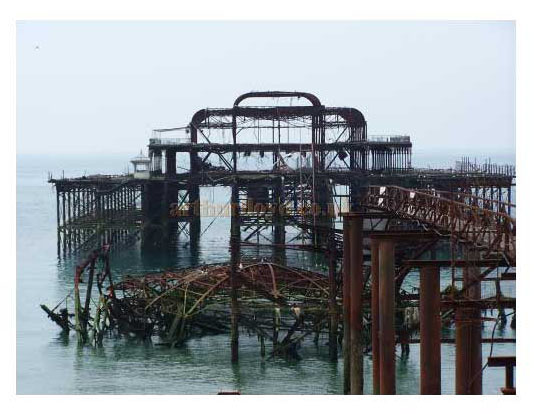
Above - Part of the pier collapses - Sunday 29th December 2002. Later, The Pavilion catches fire (28th March 2003)
Image from the BBC's Brighton webcam